


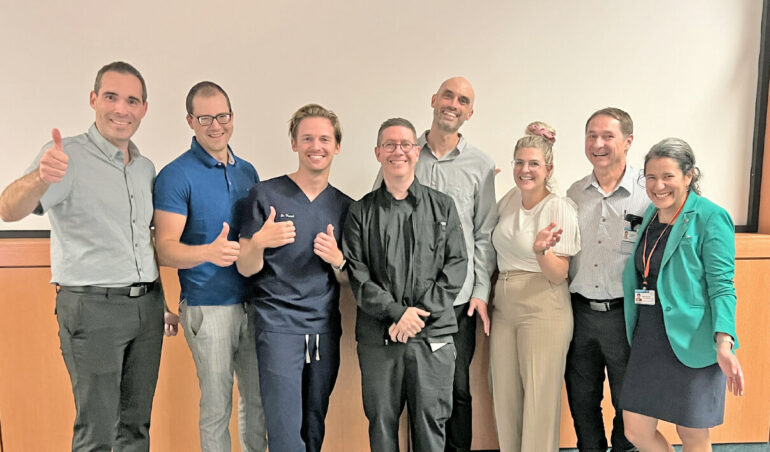
Innovation in medical imaging is essential to improving diagnosis and treatment. Given the labour shortage and difficulty accessing care, our project aims to integrate AI into MRI to improve image quality, expand access to care, reduce exam times and improve the patient experience.
During the first phase of the project, first-generation AI enabled us to accelerate image acquisition by a factor of around 50% without compromising accuracy and quality. Each MRI device equipped with this technology is now able to handle approximately 25 more patients per week (15% increase), as the scan time is reduced by approximately 15 minutes thanks to AI image reconstruction. In October 2025, two of the nine MRI devices at the CHU de Québec – Université Laval were making full use of AI, and we began applying this approach to a third unit. For that month alone, we completed 250 more scans than in 2024, which would represent an annual increase of over 3,000 scans. We also performed 13% more contrast scans, which have added therapeutic value (such as for cancer diagnosis).
As at December 2025, six out of nine MRI devices are now using AI. Our innovation has significantly improved scan experience and quality, particularly for pain sufferers and pediatric patients. In addition, the risks associated with performing MRI examinations under anesthesia—particularly for pediatric patients—may be reduced.
Lead:
Éric Poulin, Medical Physicist
Contributors:
Gilles-Philippe Harvey, Head, Medical Imaging, CHU de Québec – Université Laval
Marc-André Hamel, Radiologist, CHU de Québec – Université Laval
Christian Berthelot, Radiologist, CHU de Québec – Université Laval
Samuel Poulin, Technologist, CHU de Québec – Université Laval
Vanessa Blouin, Director, Oncology, CHU de Québec – Université Laval
André-Guy Martin, Radiation Oncologist, CHU de Québec – Université Laval
Maria-Gabriela Ruiz Mangas, Director, Oncology, Santé Quebec


